


 中文简体
 عربى
Content
Feed a punched card into the reader, pass the carriage across the needle bed, and every hole in that card decides which needles rise to form a stitch. That mechanism kept the knitting machine with punch cards at the center of home and small-workshop knitting for decades. The short answer for anyone weighing a purchase now: a punch card machine remains a good tool for hobby knitting and for learning how needle selection works, but for any real production volume, computerized flat knitting machines beat it on pattern size, setup speed, and consistency. The rest of this article explains how punch card machines work, where their limits sit, and what the machines that replaced them can do.
What a Knitting Machine with Punch Cards Is
A punch card knitting machine is a mechanical flat bed machine that stores its pattern on stiff cards about as wide as the needle bed itself. A 24-stitch repeat became the de facto standard on most home models, which is why so many published charts are built on 24-column grids. Each card row corresponds to one knitting course, and the machine reads those rows one by one as the carriage travels back and forth.
The reading process is purely mechanical. Where the card is solid, a pin presses against the selection mechanism and holds the needle back. Where a hole is punched, the pin drops through and lets that needle rise. The motif repeats across the bed as often as the needle count allows, so a 200-needle bed shows eight full repeats of a 24-stitch pattern in every course, with the remaining needles following the carriage's basic cam setting.
How a Punch Card Controls Each Stitch
A hole does not mean "knit" by itself. The combination of the punched row and the cam setting chosen on the carriage decides what the selected needles do: knit a stitch, hold the old stitch and skip the new one (slip or miss), or lift the previous loop back onto the needle (tuck). The same card can therefore produce very different fabrics depending on the lever positions, which is part of why these machines reward experimentation.
Designers can also punch their own cards instead of relying on published charts. The workflow comes down to three practical steps:
- Mark the design on the card grid, keeping the repeat within 24 columns and blocking out the rows that build the pattern.
- Punch the marked squares with a card punch, keeping the holes clean so the reader pins pass through without catching.
- Label the card with the pattern name, cam settings, and row count so it can be found and reused reliably later.
Blank card packs and long card rolls each have a place here: short cards suit small repeats, while a roll carries far more rows than a single card, which suits textured designs that take many courses before they repeat.
The Practical Limits of Punch Card Systems
The mechanism works, and a well-maintained vintage machine still produces lovely fabric. The limits surface the moment you move from knitting a given pattern to designing and producing:
- Pattern width is capped at the 24-stitch repeat. Wider motifs require workarounds, and the repeat tiles across the bed whether the design calls for it or not.
- Editing means re-punching. One misplaced hole changes the design, and a mistake costs a card rather than a keystroke.
- Shaping is manual. Necklines, armholes, and decreases are counted and moved by the operator, which slows work and invites errors across a batch.
- Color work depends on manual yarn changes, so multi-color jacquard beyond simple two-color patterns becomes labor-intensive.
- Mechanical parts wear out. Card readers, feed mechanisms, and the cards themselves degrade with use, and replacement stock for older models is scarce.
None of these are deal-breakers for a hobbyist knitting a scarf. For a workshop producing dozens of panels a day, they translate directly into longer changeovers, more minutes per piece, and inconsistent output between operators.
From Punched Cards to Digital Needle Selection
Computerized flat knitting machines solve each of those limits by storing the pattern digitally and controlling selection electronically instead of mechanically. Understanding the needle selection mechanism makes the difference concrete: instead of a card dictating a fixed 24-stitch repeat, software actuates exactly the needles the design calls for, in every row, across the full needle bed.
Two technical routes dominate. Preselection systems choose each needle one course ahead of the knitting point, which keeps carriage speeds high on large pattern repeats. Direct selection systems actuate the needle at the moment of knitting, giving per-needle freedom for complex structures and mixed techniques. Both routes accept pattern files loaded through a USB port, so a design change becomes a file edit rather than a re-punched card.
| Factor | Punch Card Machine | Computerized Flat Knitting Machine |
|---|---|---|
| Pattern input | Punched holes on physical cards | Digital pattern files loaded via USB |
| Needle selection | Fixed 24-stitch repeat read mechanically | Per-needle control through preselection or direct selection |
| Pattern width | Capped at 24 stitches per repeat | Unconstrained across the full needle bed |
| Shaping | Manual decreases and neckline work | Programmed shaping with automatic density adjustment |
| Changeover | Swap or re-punch cards | Load a new file in minutes |
| Consistency | Depends on operator technique | Repeatable settings stored with each pattern |
Where Modern Machines Take Over Punch Card Work
Sweaters and knitwear panels
Sweaters were the product punch card machines were built for, and they remain the core application for computerized flat knitting. A double-system sweater machine knits ribs, transfers, and textured patterns from a single program, with neckline and armhole shaping written into the file instead of counted by hand at the machine.
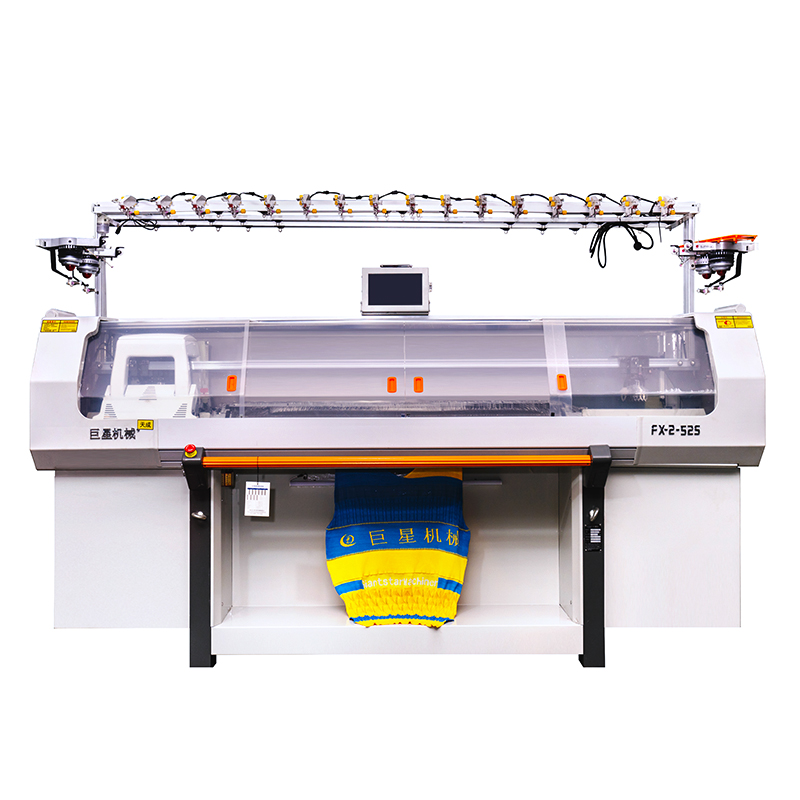 Double System Computerized Flat Knitting Machine for Sweater ProductionA double-system sweater machine that knits ribs, transfers, and textured patterns from a single program, with neckline and armhole shaping written into the knit file. It suits anyone producing shaped sweaters at production speed.View Product →
Complex stitch structures
Punch cards force every design into a 24-column grid. A direct selection machine with a milling needle plate controls knit, tuck, miss, and floating thread looping functions needle by needle, which is what makes dense, non-repeating structures practical at production speed.
 Direct Selection Single System Milling Needle Plate Flat Knitting MachineThis single-system machine uses a milling needle plate for needle-by-needle direct selection of knit, tuck, miss, and floating thread looping. It makes dense, non-repeating structures practical, replacing the 24-column limits of punch cards.View Product →
Multi-yarn and color work
Where a punch card operator swapped yarn feeders by hand, a three-system machine with an intelligent yarn feeder manages several yarns within one course sequence. The same class of technology now extends to fly knit shoe uppers, collars, and whole-garment work, applications that never existed for card-driven home machines.
 Pre-Selected Three System Flat Knitting Machine with Smart Yarn FeederThree knitting systems and an intelligent yarn feeder let this machine manage several yarns within one course sequence without manual changes. It reflects the technology that now serves shoe uppers, collars, and whole-garment work.View Product →
Should You Still Buy a Knitting Machine with Punch Cards?
Buy one if you want it for what it is: a mechanically honest machine that teaches how needle selection works, knits attractive fabric at a hobby pace, and costs little secondhand. Before paying, confirm that the card reader feeds cleanly and that blank cards for that model are still available, because a worn reader turns every pattern into a frustrating session.
Buy a computerized flat knitting machine if the goal is output. When comparing suppliers, look past the brochure and check the details that determine uptime: whether core parts are manufactured in-house, whether every machine is tested under load before delivery, and how the after-sales system handles fault diagnosis. Manufacturers such as Giant Star Machinery, which builds sweater, shoe upper, and collar machines on preselection and direct selection platforms and tests each unit for 24 hours before shipment, set the benchmark any serious supplier should meet.
The punch card earned its place in knitting history by putting pattern control directly in the operator's hands. Its modern successors keep that idea and remove the ceiling: every needle, every row, selected by software.





