


 中文简体
 عربى
Content
- 1 What Exactly Makes the Machine "Computerized"
- 2 Direct Selection Versus Preselected System
- 3 How System Count Affects Output and Cost
- 4 What Can Be Made with a Computerized Flat Knitting Machine
- 5 Why Factories Are Moving to Computerized Flat Knitting Machines
- 6 What to Check Before Buying a Computerized Flat Knitting Machine
- 7 The Bottom Line
A knitting factory that wants to add a new sweater style rarely starts with yarn color. It starts with a machine question: which device can turn the design into a knitted panel at the speed, consistency, and cost the order requires. For most modern mills, the answer is a computerized flat knitting machine. Put simply, it is a computer-controlled weft knitting machine with two flat needle beds and a carriage that travels across them. Cam-driven latch needles, guided by a digital pattern program, turn yarn into shaped knit fabric row by row.
What Exactly Makes the Machine "Computerized"
A computerized flat knitting machine is, at its core, a double-needle latch weft knitting machine. The needles sit in parallel grooves cut into two flat needle plates — a front bed and a rear bed — with the needle hooks facing each other. This double-bed layout is what makes rib and other elastic two-sided structures possible.
During knitting, the carriage moves back and forth across the needle beds and carries the cam systems with it. The triangular cam device works like a set of plane cams: the butt of each needle enters a cam groove, and as the carriage advances, the cam tracks force the needle to rise and lower in a controlled rhythm. The hook catches the yarn, the latch closes, and a new loop is formed. When the front and rear beds work alternately, the machine produces rib; when needle activation is selective, it produces jacquard, cable, and shaped panel structures.
The word "computerized" describes the control layer that coordinates all of these actions. The control system reads the pattern file, sends signals to the needle selection and yarn feeding mechanisms, and adjusts carriage speed, racking distance, stitch density, and yarn tension at the exact moment each is needed. In practical terms, an operator changes a style by loading a new program instead of re-setting cams by hand.
Direct Selection Versus Preselected System
The largest practical difference between machine models lies in the needle selection mechanism. Selection decides which needles knit, tuck, or stay idle on each row, and that decision creates every pattern and shaped edge on the fabric.
Direct selection
With direct selection, each needle can be chosen individually at the knitting point. The control system activates a selector element for each needle, and the needle responds immediately. This gives the highest pattern freedom: stitches can differ from one needle to the next on the same row, which is exactly what intricate jacquard, openwork, and shaped collars require. Direct selection also reacts quickly when the pattern changes across a panel, and it is often combined with full inserted needle plates or milling needle plates for better needle stability. The article on the direct selection system with its optimized needle selection algorithm explains the mechanism in more detail.
Preselected system
A preselected system prepares the selection in advance. The machine organizes the needles into groups and pre-loads their position according to the pattern before the carriage reaches the knitting zone. This removes part of the selection work from the high-speed moment of knitting, so the carriage can run faster and the machine stays productive on long, repetitive runs. That is why preselected machines dominate double-system sweater production and three-system shoe upper production, where volume matters as much as pattern complexity. A step-by-step view is available in how a preselected system works on a computerized flat knitting machine.
How System Count Affects Output and Cost
System count refers to the number of full cam systems mounted on the carriage. It is one of the first specifications a knitting factory checks, because it scales productivity directly on the same knitting width.
A single-system machine has one cam system. Each carriage traverse knits a single row of stitches, which makes it the most economical configuration for basic fabrics, collar production, and sample development.
A double-system machine carries two cam systems and knits two rows per traverse. Output nearly doubles on long panels, and the second system makes stitch transfers and two-color jacquards much more efficient. Double-system machines are the standard for sweater mills.
A three-system machine carries three cam systems and targets maximum production speed. To keep three systems supplied with yarn, these machines are typically equipped with smart yarn feeders. Three-system models are common in fly knit shoe upper manufacturing, where different color zones and density areas are knitted continuously.
| Specification | Single System | Double System | Three-System |
|---|---|---|---|
| Cam systems on the carriage | 1 | 2 | 3 |
| Rows knitted per full traverse | 1 | 2 | 3 |
| Relative output level | Baseline | About double on similar designs | Highest, with matching yarn feeding |
| Typical applications | Collars, samples, simple fabrics | Sweaters, jacquard, cardigans | Shoe uppers, multi-color high-volume fabrics |
| Machine complexity and cost | Lowest | Moderate | Highest |
The practical rule: choose the lowest system count that still runs your most complex product at an acceptable speed. A trim workshop does not need a three-system carriage, while a shoe upper factory cannot afford the low output of a single-system machine.
What Can Be Made with a Computerized Flat Knitting Machine
Sweaters and cardigans
The most common application remains sweater and cardigan production. The machine knits body panels, sleeves, collars, and trims as flat or shaped pieces, and the panels are then seamed. A preselected double system computerized flat knitting machine built for sweater production is the workhorse of many sweater mills: the double system keeps output high, while the preselected mechanism handles ordinary jacquard and stripe patterns without slowing down.
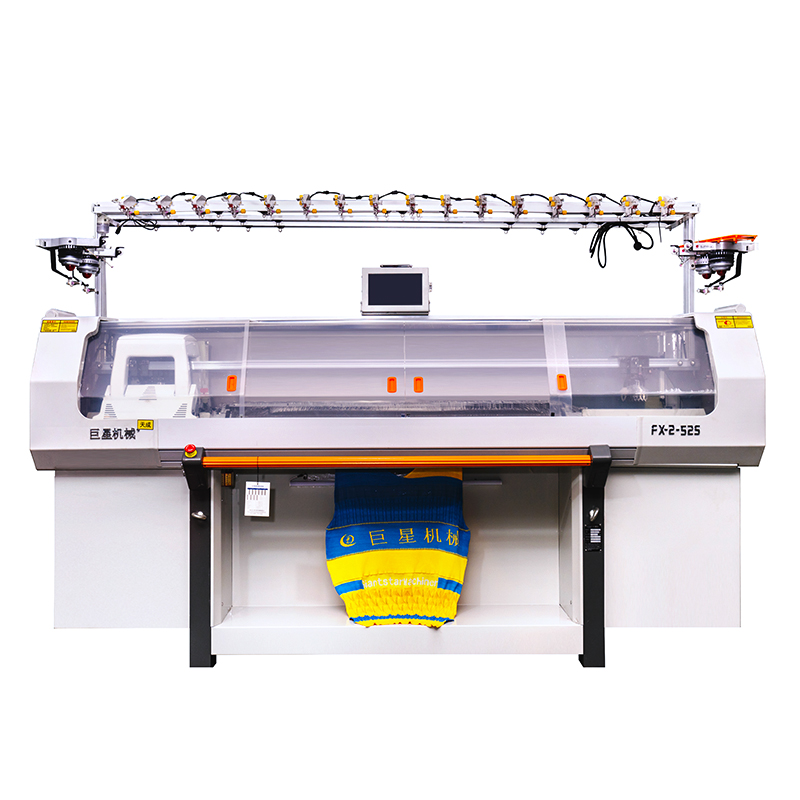 Wholesale Pre-selected double system computerized flat knitting machine (sweaterZhejiang Tongtai Intelligent Technology Co., Ltd is China Wholesale Pre-selected double system computerized flat knitting machine (sweate...View Product →
Collars, cuffs, and bottom trims
Garment factories use dedicated collar machines for neckbands, cuffs, and plackets. These small parts must hold their dimensions after washing and sewing, so precision matters more than speed. The direct-selection double-system collar machine provides the needle-by-needle control needed to keep edges stable and stitches even.
 Wholesale Direct selection double system Collar machine Company, FactoryZhejiang Tongtai Intelligent Technology Co., Ltd is China Wholesale Direct selection double system Collar machine Company and Factory. ...View Product →
Fly knit shoe uppers
Fly knit shoe uppers are shaped one-piece uppers knitted from polyester or nylon yarn. The upper must combine flexible instep zones, firmer heel and toe areas, and multi-color patterns in a single knitted piece. A preselected three-system fly knit shoe upper machine is built for this job, with three systems for productivity and smart yarn feeding for clean color changes.
 Wholesale Pre-selected three system fly knit shoe upper computerized flat knittiZhejiang Tongtai Intelligent Technology Co., Ltd is China Wholesale Pre-selected three system fly knit shoe upper computerized flat knitt...View Product →
Whole-garment (seamless) knitting
Whole-garment machines take the idea one step further: the complete garment, including body, sleeves, and trims, is knitted in one piece with no linking seams. This eliminates a major sewing step and reduces material waste. The machines cost more and place stricter demands on yarn quality, but the economics work well for high-value knitwear and smaller batch production.
Why Factories Are Moving to Computerized Flat Knitting Machines
Conclusion first: factories replace manual and mechanical flat machines for four measurable reasons — pattern-change speed, consistency, labor efficiency, and output per square meter of floor space.
- Pattern-change speed: a style change that used to require hours of mechanical adjustment is now a matter of loading a file, changing the yarn, knitting a short test panel, and starting the run.
- Consistency: every panel repeats the same stitch density, the same tension settings, and the same needle sequence, so the risk of human error falls sharply.
- Labor efficiency: one operator can monitor several machines, and dependence on highly skilled manual knitters drops. Training focuses on machine operation and pattern software instead of hand-knitting technique.
- Waste reduction: programmed knitting shapes panels economically and reduces the number of defective pieces, which lowers yarn consumption and rework cost.
These advantages explain why computerized flat knitting machines have become the production standard in sweater, accessory, and footwear supply chains.
What to Check Before Buying a Computerized Flat Knitting Machine
Match the selection principle to your product mix
If your orders are long runs of the same style, a preselected machine delivers more output. If you survive on frequent style changes and complex patterns, direct selection gives more flexibility on every order. Review the actual pattern library of your orders before choosing.
Gauge, knitting width, and system count
Gauge determines the yarn count and fabric density you can knit — a coarse 3-gauge machine is for bulky knits, while a fine 18-gauge machine is for lightweight fabrics. Knitting width limits the maximum panel size, and system count decides the output level. All three must fit the products you actually sell, not the ones you display in a showroom.
Core components, testing, and certification
Needle plates, cams, and the carriage take the mechanical load every working hour, so ask where the core parts come from. Manufacturers that produce needle plates and other critical components in-house can usually hold tighter tolerances and supply spare parts faster. Check what happens before delivery: a serious supplier runs every machine continuously, and 24 hours of run-in testing is a practical benchmark. Material safety certification such as OEKO for the finished knitwear shows that the machine itself does not introduce harmful substances into the fabric.
Yarn feeding and tension control
High-speed knitting punishes weak yarn feeding. Smart yarn feeders detect broken yarn, knots, and feeding mistakes immediately, while tension control keeps stitch size even across the panel. On three-system machines these features are not optional extras; they are necessary to use the installed productivity. A practical checklist of key features to consider when choosing a garment flat knitting machine covers these points in more detail.
The Bottom Line
A computerized flat knitting machine is a programmable production platform, not a single-purpose tool. The right machine is the one whose selection method, system count, gauge, and yarn feeding match the products and order structure you actually run. Start from that framework, verify the manufacturer's component quality and testing discipline, and the purchase decision becomes much clearer.





